


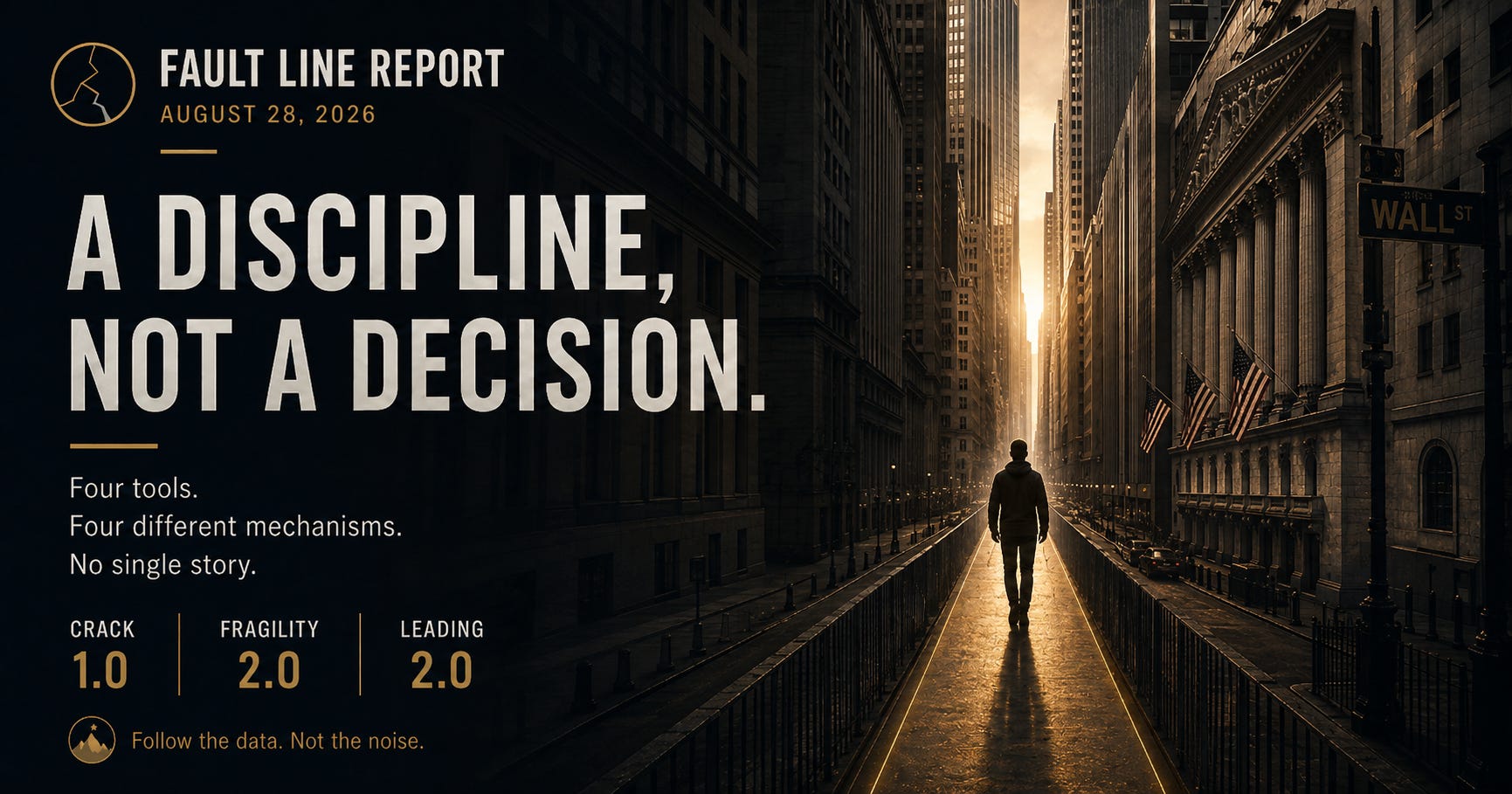
Crack 1.0. Fragility 2.0. Leading 2.0 — its highest reading of the month. Four separate tools, watching four separate mechanisms, all pointed the same way heading into today: credit compressing hard, near-term stress calm, valuation stretched, and one forward-looking signal lit up. Then Kevin Warsh gave his first Jackson Hole keynote as Fed Chair, and the market spent the day arguing with itself about what it meant. I’ve watched a lot of these speeches over the years. I don’t think I’ve ever seen one leave the room this divided.
“I stand here today committed to a discipline, not to a decision.” That’s the sentence Warsh chose to define his whole approach — and it’s about as deliberately unclear as a Fed Chair can get. He reaffirmed that inflation is running above target and that “the Fed’s predominant focus right now should be on prices,” language read as mildly hawkish. But he offered no forward guidance, no reaction function, nothing markets could actually trade against. If you were hoping for clarity, you picked the wrong Fed Chair.
The result was genuine confusion, not a clean verdict — and I mean that literally, not as a figure of speech. One research director summed it up better than I could: stocks traded as if the speech was dovish, while gold, the dollar, and bonds all moved as if it was hawkish. Same thirty minutes. Opposite readings. Short-term Treasury yields ticked higher on the inflation-focused language anyway. By midday, the major indices had settled into modest gains — the Dow on pace for its first winning week in three — after whipsawing both directions through the morning. Nobody, across every corner of the market, fully agreed on what today actually told them. Neither do I, honestly, and I’ve been doing this long enough that I’d usually have a stronger opinion by now.
This week’s real story sits underneath the speech, not in it. Nvidia’s Wednesday earnings beat estimates across the board and guided to 70% revenue growth for fiscal 2028 — a number analysts hadn’t priced in. The stock’s 8.7% jump was its best post-earnings reaction in several quarters, and it dragged software and chip names higher with it. That single event did more to move markets this week than anything the Fed said today, and it’s worth sitting with that for a second: a chip company’s quarterly guidance outweighed the Fed Chair’s first major address. That tells you something about where the market’s actual attention lives right now.
And it’s exactly why this week’s scorecard is worth reading component by component, not as one number. Crack fell to its lowest reading of the month as rates and oil both eased. Credit spreads compressed to 263bps with the sharpest 21-day velocity we’ve tracked all month — the market’s clearest “not stressed” signal, and frankly the one I trust most out of everything here. Meanwhile Leading climbed to 2.0, its highest reading yet, on two independent, simultaneously-confirming components: the yield curve moved into what the framework flags as a steepening-off-inversion pattern, and breadth hit its maximum reading — both the 5-day and 21-day windows now confirming the same sustained, narrow, mega-cap-led leadership. Two structural signals agreeing at once is a meaningfully stronger flag than either alone, and it’s the piece of this week’s data I keep coming back to.
Layered on top: a broader valuation check we ran for the first time this week. Market value relative to the size of the economy — the same measure that flagged both the 2000 and 2021 peaks — sits at the 98th percentile of its history since 1970. That’s more stretched than the dot-com top itself, which is a strange sentence to type out loud. It’s not a timing tool; the same measure was elevated for a full year before the 2000 peak actually arrived, which is exactly why we’re treating it as context, not a trigger. But it’s a real, separate data point, and I’d be lying if I said it didn’t give me pause.
Set against that: the one number that’s mattered most all month still hasn’t moved the wrong way. Bank lending conditions — a direct read on whether banks are quietly tightening standards before trouble becomes visible in public markets — read flat to easing this week. Banks are not currently pulling back credit. That’s the same read this indicator gave in the two years before the actual 2007-2008 credit crisis broke, which I’ll admit surprised me when I first saw the historical numbers earlier this week. Useful humility, not an all-clear.
What I’m watching next: whether Leading’s dual confirmation holds through another week, whether credit conditions data shifts as the quarter progresses, and whether the market’s confused reaction to Warsh resolves into something clearer once it’s had a weekend to sit with it. For now: four tools, four different mechanisms, no single story — which is, itself, an honest description of where things actually stand. I’d rather tell you that plainly than force a conclusion the data isn’t giving me.
— Fault Line Report, August 28, 2026