


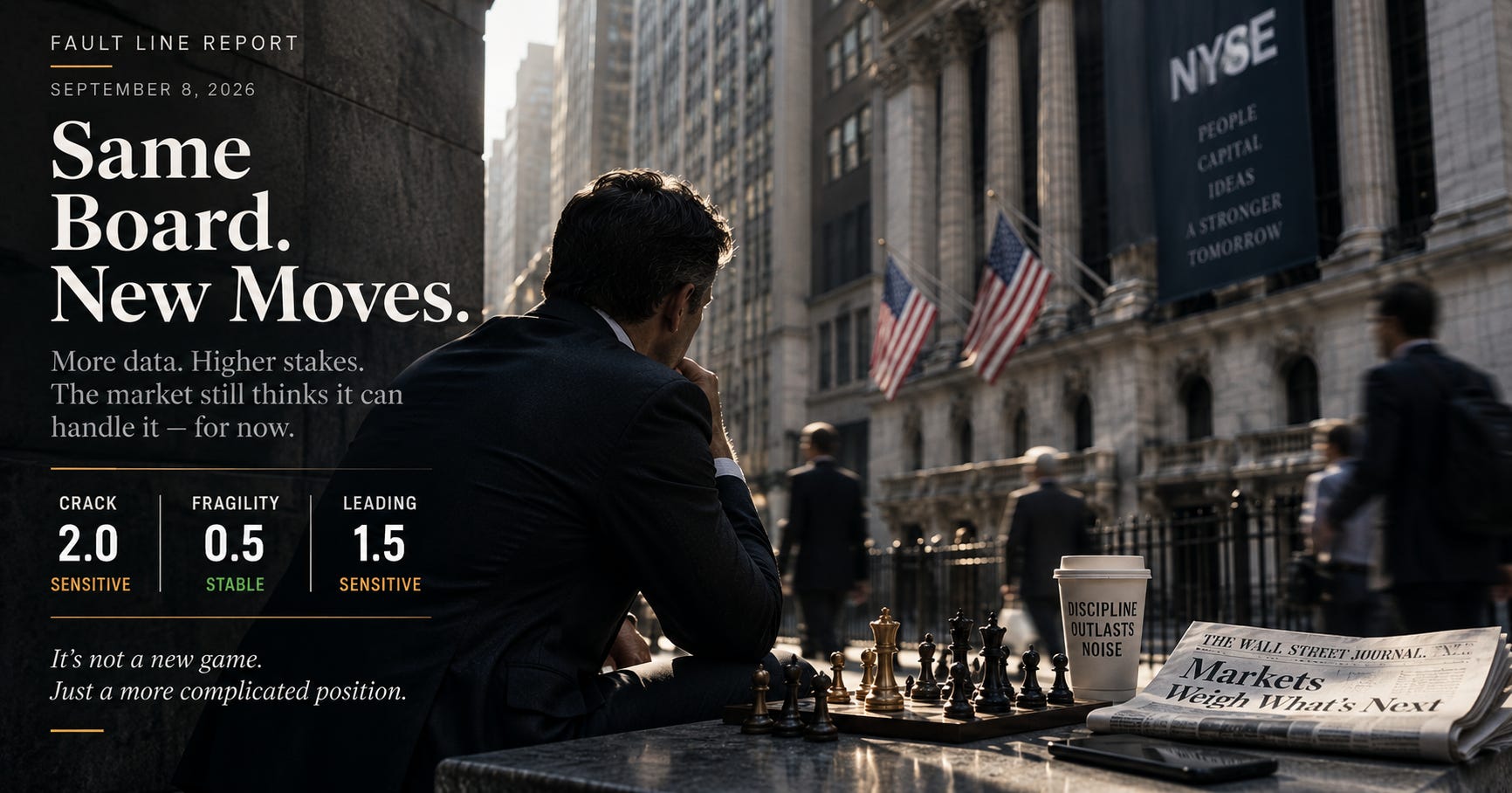
Crack 2.0. Fragility 0.5. Leading 1.5. The scorecard has barely moved over the past week — which is almost funny, given how much actually happened in that time.
Friday gave us the cleanest “good news is bad news” moment of the year. August payrolls came in at 162,000 — nearly triple the 53,000 economists expected, the strongest print since March. June and July both got revised up, adding a combined 55,000 jobs to what we thought we knew about the summer. This should have been an unambiguous relief after the contraction scare we spent weeks tracking in July. Instead, stocks fell. The Dow dropped half a percent, the S&P and Nasdaq both slid, and September rate-hike odds jumped from roughly 50% to 58% in a single session. A strong economy, in this particular moment, reads as permission for the Fed to keep leaning hawkish rather than as a reason to relax. I don’t love writing sentences like that, but it’s what the data actually did.
Over the weekend, the geopolitical thread got a real update, not just more of the same. Iran announced it will establish a restricted maritime zone in the Strait of Hormuz, with shipping-lane boundaries reportedly being finalized with Oman. That’s a concrete, structural escalation — not another round of strikes and counter-strikes, but a formal claim over how ships move through one of the world’s most important oil corridors. The conflict is now in its seventh month, and the U.S. Energy Secretary said this weekend that a nuclear agreement with Iran may not happen at all under the current administration — “it may simply be destroying their capabilities,” in his words. Oil responded the way you’d expect: Brent pushed back above $98, WTI above $93, both climbing through the weekend on a session most markets were closed for.
And yet the score itself has held almost perfectly steady. Crack sits at 2.0, same as it’s been for most of the past week, driven by the same two things — rates (30Y still pressing through 5.25%) and oil (through $90 and climbing). Fragility, which dropped sharply a few days ago as some of the more subjective inputs eased, has stayed low. Leading ticked up slightly to 1.5 as breadth confirmed narrow leadership across both the short and longer windows we track — the market’s gains are still concentrated in a smaller set of names than the headline index suggests.
Worth being honest about what’s driving the calm, since it’s the same thing it’s been for a month: credit still hasn’t blinked. Spreads are still tight, still trending in the reassuring direction. Every real historical comparison we’ve made this year — 2000, 2007, 2018, 2022 — points to credit as the input that actually separated a contained scare from something structural. Right now, across a genuine rate-hike repricing and a real escalation in the Middle East, credit is telling you this is still being absorbed, not spreading.
Where this leaves things heading into the week: next week’s CPI and PPI reports are being flagged everywhere as the real decision point for the Fed’s September meeting — more than jobs, more than Friday’s reaction. If inflation data comes in hot on top of a strong labor market, the case for holding gets a lot harder to make. If it cools, the Fed gets room it didn’t have a week ago. Either way, I’d rather wait for that data than guess at it here.
— Fault Line Report, September 8, 2026