


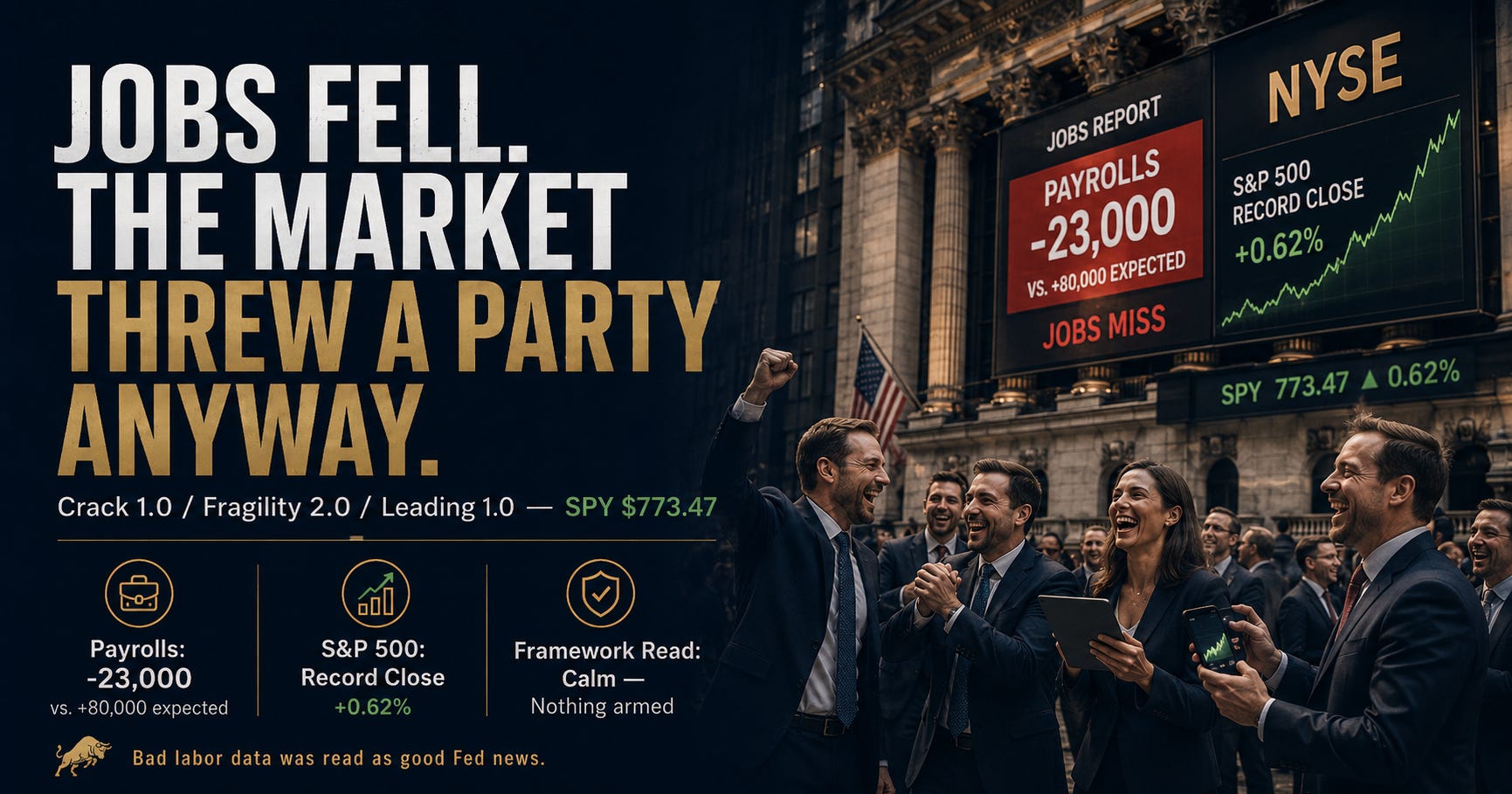
Friday delivered a real surprise, and the market’s reaction to it is the actual story worth telling. July nonfarm payrolls fell by 23,000 — economists had expected a gain of roughly 80,000. May and June were revised down by a combined 103,000 on top of that. Unemployment ticked down to 4.1%, but for the wrong reason: labor force participation kept sliding, hitting its lowest level in over five years. Wage growth slowed too.
By the old playbook, that’s bad news. The market didn’t read it that way. The S&P 500 closed at a fresh record — 7,757.64 — up 0.62% on the day. The Dow and Nasdaq gained too. The logic traders were pricing: a weak labor market removes the pressure on the Fed to hike — which had actually been the live fear all week, not whether a cut was coming. Northlight Asset Management’s CIO called it a genuine reframe, shifting the market’s attention from pure inflation risk toward labor-market risk instead. Money markets still see a possible hike sometime in 2026, but pushed out to December at the earliest.
The full week, now complete, was genuinely strong. S&P +3.5-3.6%, its best week since April. Nasdaq +4.8-5.2%, best since May. Underneath it: three record closes, a 77% earnings beat rate, and Friday’s jobs miss actually adding fuel rather than taking it away. One thing worth flagging plainly, though — gold also jumped, +2.4% Friday alone, its best week in seven months. That’s not nothing; some capital hedged even while equities partied.
The framework’s own read stayed measured through all of it. Crack sits at 1.0, near the calmest reading in weeks. Oil holds in the $81-87 range — WTI $81.17, Brent $86.62 — above $80 but still well below the $90 line that had kept the inflation score elevated back in July. Rates remain the one persistently elevated input: the 30-year sits at 5.22%, and the curve continues its steepening pattern (2s10s +0.44) that’s been a running thread all month. Nothing’s armed — no tranches, main or fast, anywhere close to triggering.
Worth naming the real tension here directly: last week’s rally wasn’t built on unambiguous good news — it was built on bad labor data getting read as good Fed news. That’s a more fragile kind of optimism than earnings-driven strength alone, and it’s worth watching whether the next data point (inflation, the next jobs report, a Fed comment) reinforces this read or unwinds it.
No forecasts. No trade calls. This is a transparent read of a proprietary framework, published as it happens — including the weeks the market’s own logic gets a little harder to explain in one sentence.