


On Thursday, Alphabet fell seven percent and Tesla fell fourteen. Both had beaten. The Magnificent Seven basket had its worst day since April 2025, down 5.27 percent. Oil touched $100 a barrel for the first time this cycle.
If you watched the tape, it looked like the beginning of something.
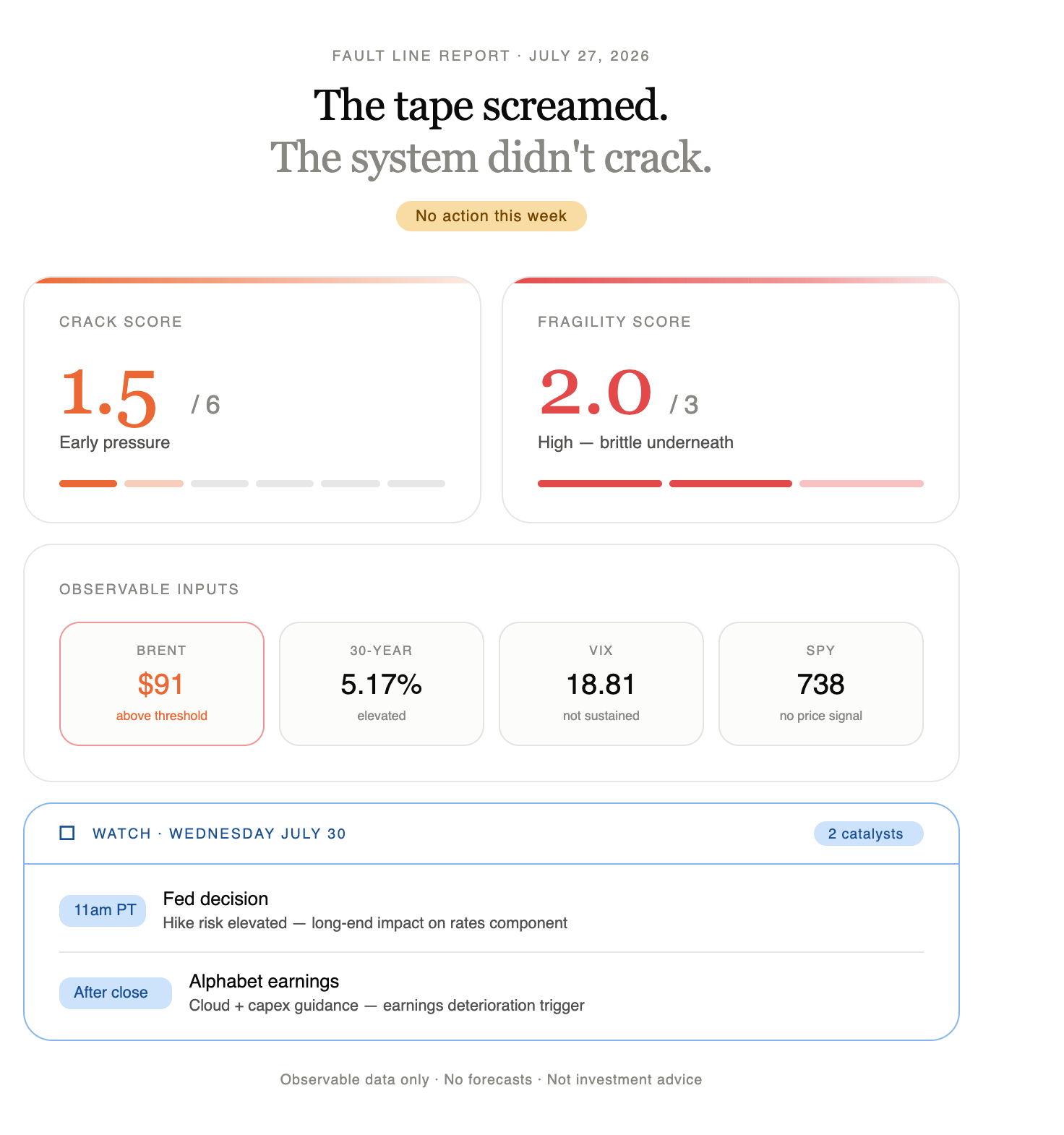
The framework scored it 1.5 out of 6.
That gap — between what the screen felt like and what the data confirmed — is the subject of this letter. The point of scoring a market instead of reacting to it is that the score doesn’t care how the day felt.
What actually cracked
Two things, and only two.
Oil. Brent at $91.23, WTI at $84.46 as of Monday morning. That is the single largest contribution on the board. The Iran escalation drove oil to $102 last week — the highest this cycle. The inflation component still scores at 1.0 because Brent remains above $90, but that threshold is now exposed.
The long end. The thirty-year at 5.17 percent — elevated, not disorderly. The 2s10s spread sits at +0.34, positive and mildly steepening. Worth watching precisely because steepening after an inversion is the dangerous pattern, not the inversion itself. It isn’t there yet.
That’s the entire Crack score.
What didn’t crack
The more important half, and the half nobody discusses during a red week.
Credit did not confirm. High-yield spreads remain tight. No widening, no velocity, nothing. Credit is where real stress appears before equities work it out, and credit is asleep. In four prior stress episodes — the 2024 yen carry unwind, the 2025 tariff selloff, the October 2025 regional bank scare, the Iran conflict in February — spreads never broke into true distress territory, and all four reversed within weeks. When credit doesn’t confirm, an equity move is usually a repricing rather than a rupture.
Labor did not crack. Unemployment 4.2 percent. Initial claims 187,000 — nowhere near a level that would register. Companies are not shedding workers.
Volatility did not sustain. The VIX closed at 18.81 Friday. Across the last thirty sessions it has spent zero days above 22. Not one. A market in genuine distress does not keep its volatility index in the teens.
Three categories, three zeros — measured, not missing.
The gap is the signal
Crack 1.5. Fragility 2.0.
Low confirmed damage. High reaction potential. Positioning is stretched, breadth has narrowed to where a handful of names carry the index, earnings momentum is concentrated in exactly the companies that just got hit, and a live geopolitical catalyst has moved oil twenty percent in a month.
Calm surface. Brittle underneath.
This is a market that hasn’t broken but would break loudly if something did. It is not a signal to buy and not a signal to sell. It is a signal to have your levels written down before you need them — because if a crack does confirm from here, the move will be fast, and there won’t be time to think.
A note on breadth
One technical finding, because it changed a reading.
Measured over twenty-one days, breadth this week looked healthy — equal-weight was outperforming the cap-weighted index, which normally means broad participation. Measured over five days, the same metric flagged fragility: equal-weight was outperforming because the mega-caps were taking the damage, not because the market was strong.
Both were falling. One was falling less. That is not health.
A month-long window averaged a two-day rout into nothing. The lesson generalizes — the window you choose determines the answer you get, and a slow window will tell you everything is fine right up until it isn’t.
Position
No action. Dry powder stays dry.
The framework requires two independent signals before anything moves: a score threshold and a price level on the monthly chart. Neither is met. Not close on either.
The discipline isn’t in knowing when to act. It’s in being willing to write “no action” four weeks running while the headlines insist otherwise.
What I’m watching
The Iran pause — and whether it holds. Over the weekend the US suspended its 13-night airstrike campaign and Iran confirmed it would halt retaliatory strikes as long as the pause holds. Brent fell from $102 to $91 overnight — a significant reversal of the geopolitical premium. WTI dropped to $84. The inflation component still scores at 1.0 because Brent remains above $90, but that threshold is now exposed. If diplomacy holds through the week, the oil crack could drop to 0.5 on the next reading, taking Crack from 1.5 to 1.0.
Worth noting: this cycle has seen prior de-escalations on Iran that reversed within days. The Houthis attacked Saudi targets over the weekend even as the pause held. The Strait of Hormuz remains partially disrupted. The framework scores what’s confirmed, not what’s hoped for — and right now, Brent above $90 is still confirmed.
Wednesday is the day to watch. Two events, twelve hours apart.
The Fed announces at 11am Pacific. The pipeline has been flagging hike risk above cut risk, which would add pressure to the long end and keep the rates component elevated. A surprise hike — or hawkish language that amounts to the same thing — would push the thirty-year toward 5.25 percent and add another half-point to Crack.
Then Alphabet reports after the close. If cloud revenue disappoints or capital expenditure guidance gets cut, the rotation out of tech accelerates and the earnings deterioration component starts scoring. Alphabet’s numbers set the tone for the rest of big tech earnings — one miss doesn’t crack the framework, but a pattern of misses would.
Two events, same day. If either surprises to the downside, expect an updated reading Wednesday evening.
Until then: Crack 1.5, Fragility 2.0.
The tape screamed. The system didn’t crack.
The Fault Line Report is built on a proprietary two-score framework using observable market data only. No forecasts. No opinions. No headlines that haven’t been confirmed by actual market behavior. This is not investment advice.