


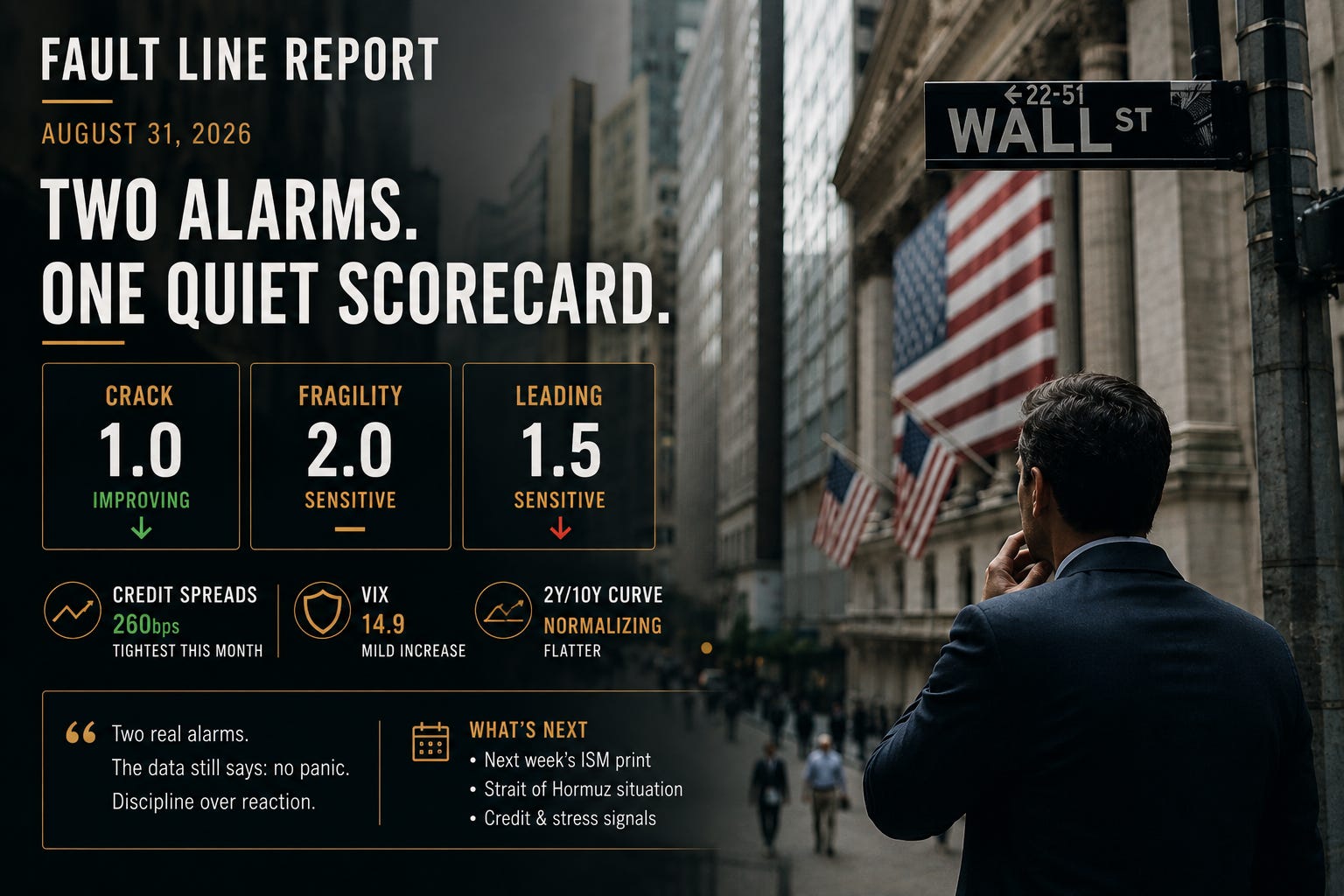
Crack 1.0. Fragility 2.0. Leading 1.5. Lower than a week ago, actually — which is a strange thing to be typing on a Monday that started with a military strike and ended a manufacturing survey’s best three-month run in a single print.
Let’s start with the weekend, because it was real. US forces struck Iranian rocket launchers at Larak Island on Sunday, positioned to lay mines in the Strait of Hormuz. That’s not sanctions language or diplomatic posturing — it’s a direct military action, and it ended what had been several weeks of relative calm on that front. Oil jumped as Asia opened, the dollar posted its best single day in a month, and traders leaned further into bets on a September rate hike, building on Friday’s hawkish Warsh tone. Asian equity markets took it hard — Korea’s Kospi fell 3.5% overnight, sharper than anything US futures showed heading into the open.
Then Monday added a second, unrelated alarm. The Chicago PMI, a regional manufacturing survey, collapsed to 47.1 — economists had penciled in something close to 58. That’s not a miss, it’s a double-digit swing into outright contraction in a single month, ending three months of expansion. I want to be straight about how seriously to take it: this same index did almost the identical thing back in March, dropping even further, and it’s genuinely known for this kind of volatility. Whether today’s number means anything durable comes down to one test — does next week’s national ISM print confirm it, or does Chicago bounce back on its own. Until then, it’s a real data point, not yet a real trend.
Here’s the part I keep sitting with: neither of those alarms moved the scorecard. Crack actually fell to its lowest reading in over a week. Credit spreads compressed to 260bps, the tightest read of the whole month, even tighter than Friday. VIX ticked up, but only to 14.9 — barely a shrug. A military strike and a manufacturing shock landed on the same Monday, and the market’s actual stress indicators said, essentially, and?
Worth naming plainly, because it’s a real limitation, not a footnote: the framework has no PMI feed wired in yet. This morning’s number, dramatic as it was, is invisible to Leading right now — that component still shows unscored. So part of why today looks calm is genuine calm, and part of it is a blind spot I haven’t fixed. Both things are true at once, and I’d rather tell you that than let the quiet score imply more confidence than it’s earned.
What did move, in its own quiet way: Leading eased slightly from Friday’s peak, mostly because the curve normalized back to a flatter, less alarming shape. Breadth stayed pinned at its maximum — the narrow, mega-cap-led leadership that’s defined the last two weeks hasn’t gone anywhere, weekend headlines or not.
Where I land tonight: this reads like a market that’s decided, for now, to treat both the Iran escalation and the PMI print as noise rather than signal — and the data backing that decision (credit, VIX) is genuinely reassuring, not just complacent. But “noise for now” isn’t the same as “noise forever.” Next week’s ISM print is the real test on the manufacturing side. The Strait of Hormuz situation is the real test on the geopolitical side. I’ll be watching both closer than the headline score suggests I should.
— Fault Line Report, August 31, 2026