


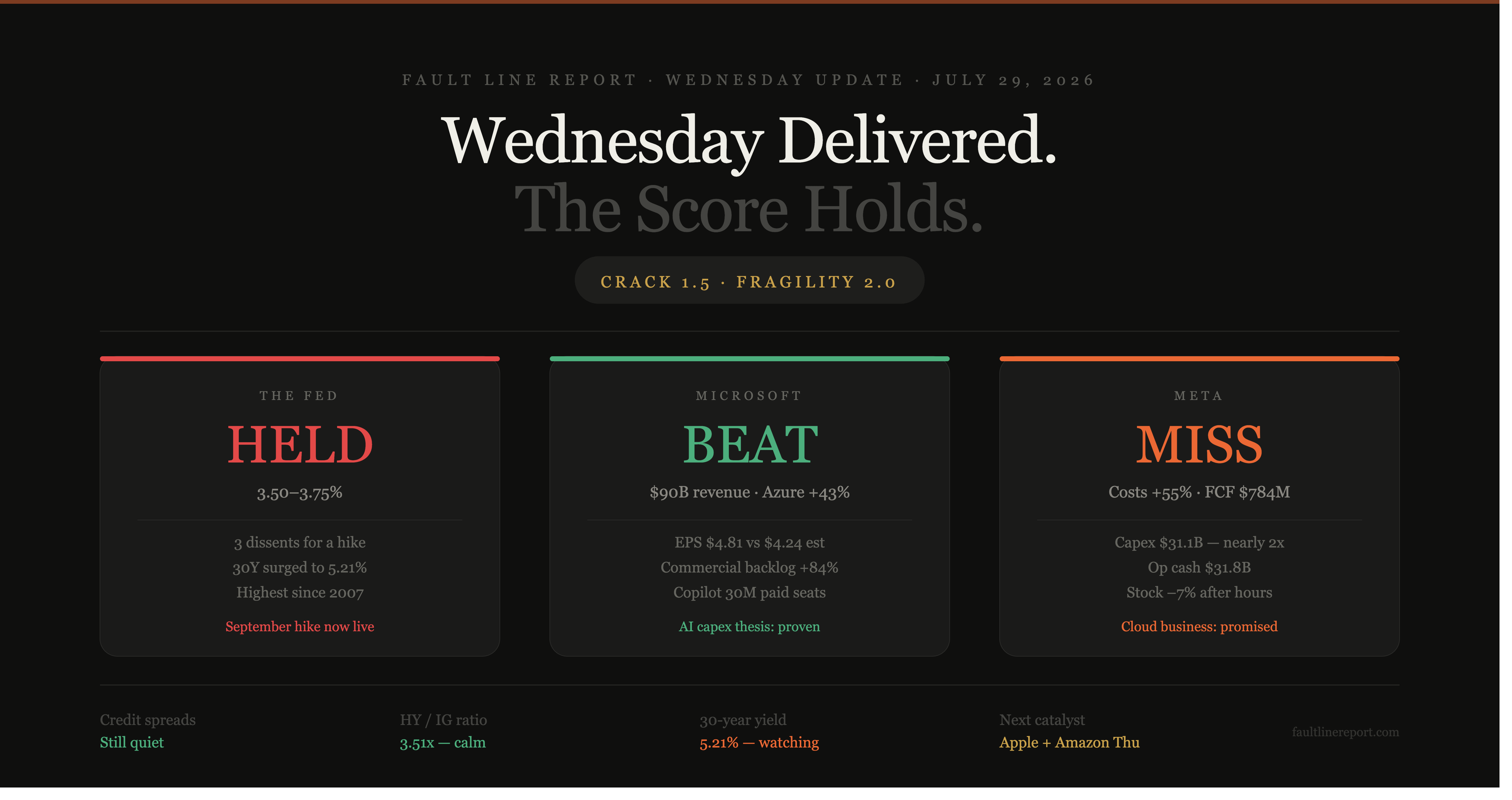
CRACK 1.5 · Unchanged FRAGILITY 2.0 · Unchanged
No action.
Wednesday promised two catalysts. Both delivered — in opposite directions.
The Fed
Warsh held at 3.50–3.75%. Three members dissented and voted to hike — the most dissents since 2016. The bond market said what it thought about that immediately: the 30-year yield surged 12 basis points to 5.21%, its highest level since 2007. The Dow fell 1,153 points.
A hold with three dissents is not a neutral signal. It means September is live, the committee is fracturing, and the long end is pricing in what the short end hasn’t done yet. The rates component of the Crack score stays at 0.5 today. If the 30-year holds above 5.25% into next week, that changes.
Warsh’s exact words: “I asked for a good family fight, and I got one.” He got one in the bond market too.
Microsoft
Azure grew 43%. Revenue hit $90 billion, up 18%. EPS came in at $4.81 against a $4.24 estimate. Stock up roughly 3% after hours.
This is what the AI trade needed. Microsoft spent $41 billion on capital projects this quarter and generated revenue growth that outpaced the spending. Azure at 43% — above the 40% threshold the market was watching — is the first clean proof that hyperscaler capex is generating returns faster than the skeptics feared. Commercial backlog surged 84%. Copilot paid seats hit 30 million.
The earnings deterioration component stays at zero. Microsoft just showed the model works.
Meta
Meta is the other side of the same trade. Costs rose 55%. Capital expenditure hit $31.1 billion for the quarter — nearly double the prior year. Operating cash flow was $31.86 billion. Free cash flow after that spending: $784 million.
A company generating $30 billion in operating cash flow and keeping less than $800 million after infrastructure spending is, as one analyst put it, becoming a utility. Zuckerberg hinted at entering the cloud business — which would justify the spending if it materializes — but that’s a promise, not a product. Stock fell 7% after hours.
Revenue grew. Earnings grew. But the cash flow picture is the early warning the framework watches for, not the headline numbers.
The AI trade is splitting
Microsoft and Meta report the same week, spend at similar scales, and get completely different verdicts. The difference is sequencing. Microsoft’s Azure revenue is already growing faster than its capex. Meta’s advertising revenue is growing, but its infrastructure spending is outrunning everything else while the cloud business that justifies it doesn’t exist yet.
That split is exactly what the earnings momentum component of Fragility is designed to track — not whether companies are beating estimates, but whether the underlying cash generation supports the investment thesis. Microsoft: yes. Meta: not yet.
The score
Crack 1.5. Fragility 2.0. No change.
The bond market is the live risk — not earnings. A 30-year at 5.21% with three Fed dissenters pushing for hikes is the component worth watching into next week. Credit spreads are still quiet. Labor is still firm. VIX elevated but not sustained.
Apple and Amazon report tomorrow after the close. Apple has no capex hangover — they’ve spent a fraction of what the others have. AWS will tell you whether Microsoft’s Azure story is sector-wide or company-specific. Friday’s post has the complete picture.
Until then: 1.5 and watching.
Observable data only. No forecasts. Not investment advice.