


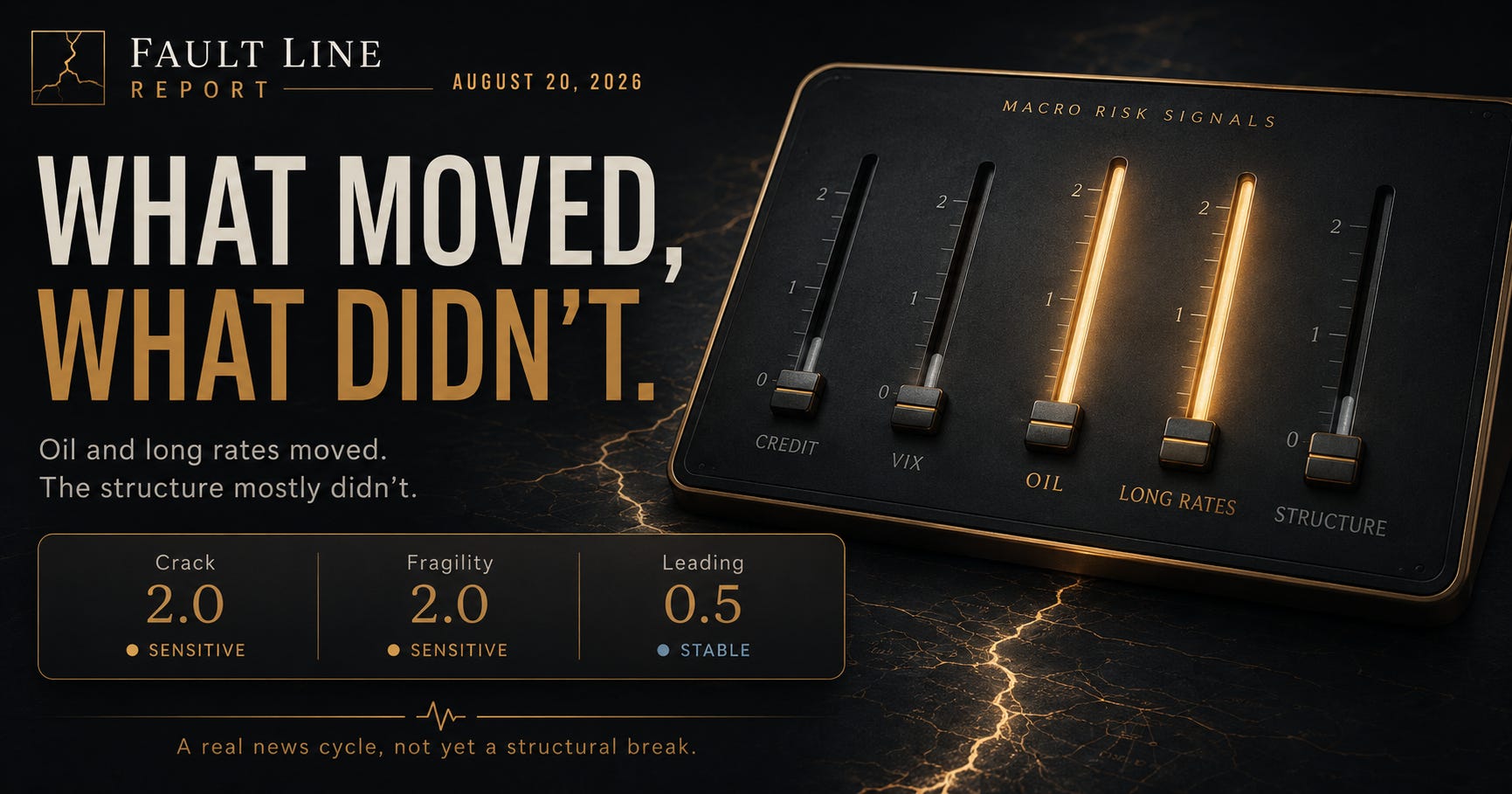
Crack 2.0. Fragility 2.0. Leading 0.5. The scorecard has sat almost perfectly still since Tuesday — which is the interesting part, because almost nothing else has.
The week’s story is oil and long rates, and it has a clear cause. An escalation in the Iran situation pushed Brent crude from the high $80s to nearly $94 a barrel over the course of the week, and the 30-year Treasury yield climbed alongside it to 5.31% — its highest level in nineteen years — before a Treasury announcement to more than double its debt buyback program pulled yields back down briefly on Wednesday. That relief didn’t hold. By Thursday, both oil and long rates were pushing higher again. SPY has drifted from $776 on Monday to $763.50 tonight — a real, mechanically explainable 1.6% decline, not a mystery move.
Wednesday added a second thread: the Fed. Minutes from the July FOMC meeting were released, and they came in more hawkish than markets had priced — three regional bank presidents dissented in favor of a rate hike, the most divided vote since 2016, even as a surprisingly weak July jobs report (payrolls fell 23,000, with 103,000 in downward revisions to prior months) sat on the other side of the scale. The committee held rates at 3.50%–3.75% regardless, but the split itself was the news: a genuine, unresolved tension between an inflation problem that hasn’t meaningfully cooled in months and a labor market that just showed its first real crack in a while.
Here’s what actually moved the score, and what it tells you about the difference between a headline and a structural shift. Two Crack components crossed real thresholds this week — rates (30Y through 5.25%, now scoring the “long-end stress” band) and inflation (Brent through $90). Both are direct, traceable consequences of the Iran story, not ambiguous signals. Fragility ticked up on breadth, which has told two different stories on two different lookback windows this week — a mega-cap-led decline masking broader resilience on one read, a more broadly-based pullback on another. Worth holding loosely.
What didn’t move is the more important fact. Credit spreads — the one input that four independent rounds of testing found actually separates a real structural crack from a contained scare — have sat essentially flat all week, drifting a handful of basis points in either direction with no clear trend. VIX never left the mid-teens. Nothing came close to sustained stress. That’s the honest read: this week looks like a textbook case of markets correctly pricing a real, live geopolitical risk into the two places that risk actually touches — energy prices and long-duration bonds — without that stress spreading into the credit markets that would signal something deeper.
Where the tranches stand: all three main tiers remain unarmed, the closest still roughly 8% below current levels. The fast-response tranche, built specifically to catch quick or shallow selloffs, also remains untriggered. The system is watching a real, live news cycle and — so far — correctly declining to treat it as more than that.
What we’re watching next: the Fed’s own dissent didn’t resolve itself this week, and it won’t until Kevin Warsh’s first Jackson Hole keynote as Fed Chair, a week from Friday. Markets have no track record yet on how he leans in a genuine crisis of competing mandates — that speech, not this week’s headlines, is probably the next real test of direction.
— Fault Line Report, August 20, 2026